AIDA Template Generation allows you to leverage generative AI to create custom phishing and callback phishing templates on demand based on your organization’s specifications. These AIDA agents allow you to better control the difficulty of your templates by simply selecting the difficulty level of the templates or, more specifically, choosing the individual Social Engineering Indicators (SEI) in the templates. For more information, view our AIDA Template Generation video.
The Template Generation Agents and the Recommended Landing Page Agent are available on the KnowBe4 console as an add-on to your Diamond-level subscription.
Creating Your Phishing Template
You can generate AI-based phishing templates. Use the following steps to access the AIDA Phishing Template Generator:
Log in to your KnowBe4 console and navigate to Phishing > Phishing Templates.
- Click the My Templates subtab.
- Click the Create AIDA Template button.
- Fill out the fields on the Phishing Template Generator page.
Using the Quick Create Template Setup
By default, the Template Setup page opens in Quick Create mode. Use this view for a fast, streamlined experience. For more information on how to use the quick create template setup, see the screenshot and list below.
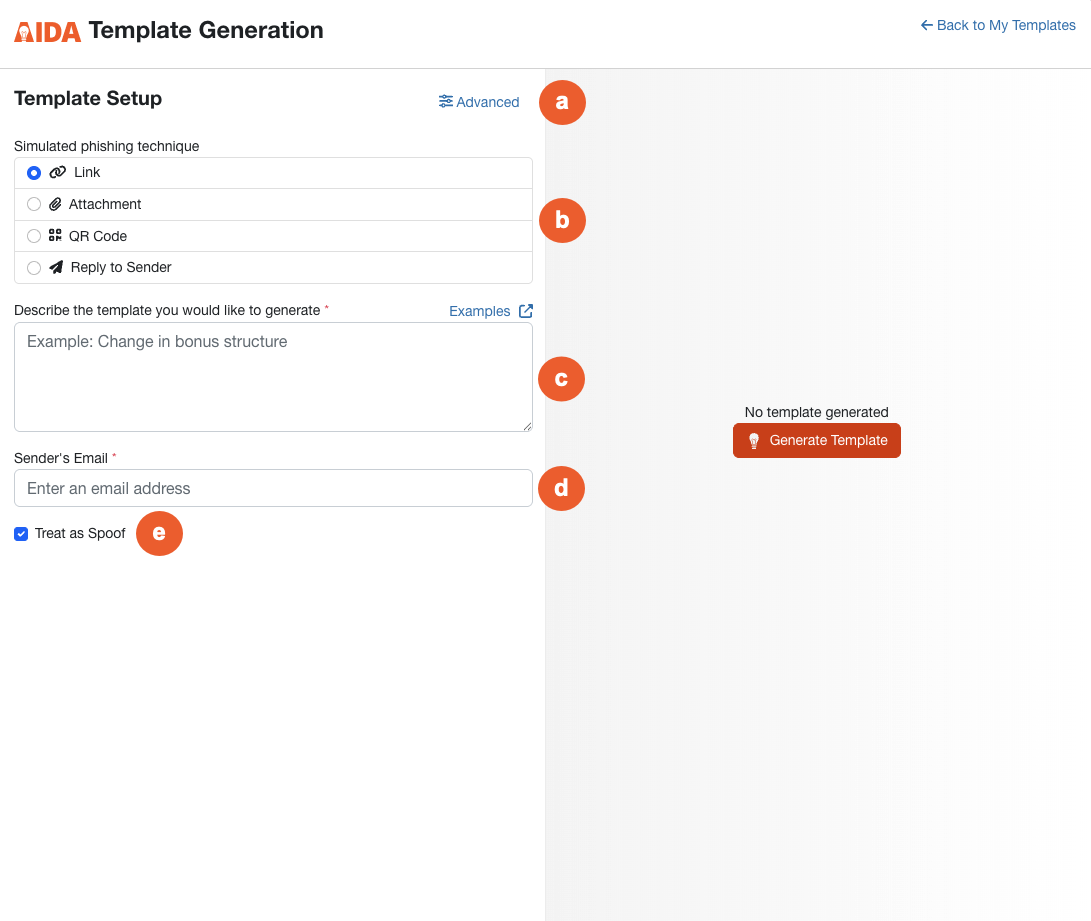
- Advanced: Select this option to view the advanced template setup options.
- Simulated phishing technique: Select the type of attack vector that you would like to include in your phishing template.
- Describe the template you would like to generate: In this field, enter a brief description of what kind of template you want AIDA to create. For more examples, see the Prompt Examples section below.
- Sender’s Email: Enter the email address you want the message to appear to come from.
- Treat as Spoof: Select this check box if you want to treat this email as a spoof and mark it as a red flag.
Using Advanced Template Setup
If you need more granular control over the tone, language, and difficulty of your template, select the Advanced link at the top-right corner of the Template Setup page. For more information on the advanced setup template, see the screenshot and list below.
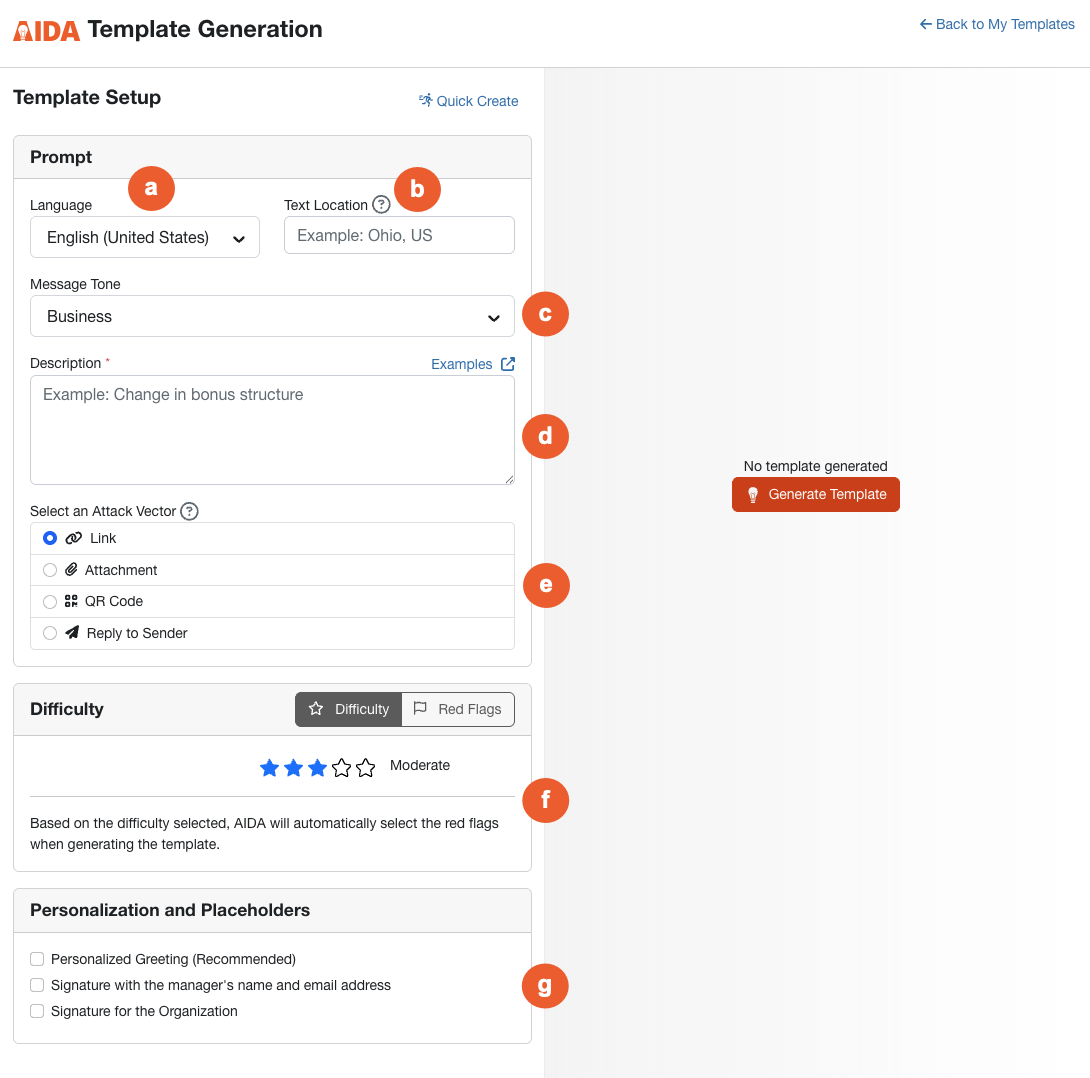
- Language: Use this drop-down menu to select the language for your phishing template.
- Text location: In this field, enter your users’ region or country to tailor the template text with the expressions, nuances, and cultural styles of their locale. Entering this information helps the template feel more authentic and relevant to your users.
- Message Tone: Use this drop-down menu to select a tone for your phishing template.
- Description: In this field, enter a brief description of what kind of template you want AIDA to create. For more examples, see the Prompt Examples section below.
- Select an attack vector: In this section, select the type of attack vectors that you would like to include in your phishing template.
-
Difficulty: Use this section to determine how challenging the simulated phishing test will be for your users. You can set the level using two methods:
- Difficulty Rating: Select a star rating from one to five, with one being the easiest to five being the most difficult. Based on the rating you choose, AIDA automatically selects the "red flags", or social engineering indicators, that will be included in the generated template. For more information, see our Template Difficulty Ratings Overview article.
- Red Flags: Select this tab to manually customize the specific red flags AIDA includes in your template. The available options change based on your selected attack vector and are organized into categories like Presentation, Common Tactic, Technical Aspect, and Language and Content. As you select flags, AIDA will display the calculated difficulty level, such as Sophisticated, for your choices.
- Personalization and Placeholders: In this section, select the type of placeholders you would like to use in your AIDA phishing template. You can choose options that are more personal or general, depending on your organization’s preferences. Your placeholders are set in your Account Settings. For more information, see our Account Information Placeholders Guide.
When you’re finished, click Generate Template. Your AIDA phishing template will appear on the right side of the screen.
Viewing Your Phishing Template
After you’ve generated your AIDA phishing template, it will automatically open so you can view it and edit it as needed to fit your organization. For more information, see the screenshot and list below.

- Regenerate: Select this button to create a new phishing template using the same prompts in the Creating Your Phishing Template section.
- Preview: Select this filter to preview your phishing template.
- Edit: Select this filter to edit your phishing template using the What You See Is What You Get (WYSIWYG) editor. For more information, see the Editing Your Phishing Template section below.
- Show Red Flags: Select this button to reveal the red flags in this phishing template. For more information, see the Where Can I Get a List of Red Flags to Use? section of our Social Engineering Indicators (SEI) Guide.
-
Landing Page: If you selected a Link or QR Code attack vector when creating your phishing template, you will see a Landing Page section. Click this button to view the landing page that will be used for the phishing template.
Note: When editing the template, you can manually select the landing page you want to use. - How did AIDA do?: Use the reaction buttons to rate AIDA’s performance in creating a phishing template. You can provide feedback on whether AIDA performed poorly, performed okay, or performed great.
Editing Your Phishing Template
After your template is generated, you can also edit it as needed to fit your organization’s style. For more information, see the screenshot and list below.

- Sender and Reply-to: In this section, enter the email address and name of the sender. Also, enter the email and name for the reply-to email.
- Treat as Spoof: Select this check box to treat this email as a spoof and mark it as a red flag.
- Subject and Body: Update the text in these fields if you want to change the subject of the email and any of the body text.
- Select Landing Page: If you want to change the landing page, use this drop-down menu to select a different landing page to use for the phishing template.
When you’re satisfied with your phishing template, click Finish and Save Template. You can view your AIDA phishing templates by navigating to Phishing Templates > My Templates. Templates created with AIDA will feature an AIDA tag.
Prompt Examples
You can use the examples below to help you generate phishing templates using AIDA. Feel free to copy and paste these prompts in the Describe the template you would like to generate field or use them as inspiration for your own unique prompt.
| Use Case | Prompt Example |
|---|---|
| IT Spoof | Make a template that looks like it is coming from our organization’s IT team, which tells the user they need to update their password before the end of the day, or they will no longer be able to log in to their account. Include a link for them to click. Make it sound very urgent and serious, but apologetic for the short timeline. |
| Business Email Compromise/CEO Fraud | Make a friendly-sounding template that looks like it is coming from our CEO. Have the CEO ask the user to please review the attached document they’ve created and provide feedback as soon as possible. The CEO should also say they understand it is an unusual request, but they were told the user is very good at this kind of thing. |
| A coworker sharing a funny video | Create a template that looks like it is coming from a coworker who shares a fake video link to what the coworker says is a very funny video. The link should look like it is taking the user to YouTube. Encourage the user to watch the video. The tone should be casual and funny. |
| Tickets for an upcoming concert | Create a template that looks like it’s coming from a local radio, saying that the user has won tickets for an upcoming concert. The link should look like it’s taking the user to the radio’s website. Make it sound very time-sensitive, and that they have to click soon or risk losing the tickets. |
| Calendar event from a coworker | Make a template that appears like a calendar invite. This email should look like it’s an automated message from the user’s calendar app with a link to the invite. |
Creating Your Callback Phishing Template
You can generate AI-based callback phishing templates. Use the following steps to access the AIDA Callback Phishing Template Generator:
- Log in to your KnowBe4 console and navigate to Callback Phishing > Email Templates.
- Click the My Templates subtab.
- Click the Create AIDA Template button.
- Fill out the fields on the Callback Phishing Template Generator page.
Using the Quick Create Template Setup
By default, the Template Setup page opens in Quick Create mode. Use this view for a fast, streamlined experience. For more information on how to use the quick create callback template setup, see the screenshot and list below.

- Advanced: Select this option to view the advanced template setup options.
- Describe the template you would like to generate: In this field, enter a brief description of what kind of template you want AIDA to create. For more examples, see the Prompt Examples section below.
- Sender’s Email: Enter the email address you want the message to appear to come from.
- Treat as Spoof: Select this check box if you want to treat this email as a spoof and mark it as a red flag.
Using Advanced Template Setup
If you need more granular control over the tone, language, and difficulty of your template, select the Advanced link at the top-right corner of the Template Setup page. For more information on the advanced callback phishing setup template, see the screenshot and list below.

- Language: Use this drop-down menu to select the language for your phishing template.
- Text location: In this field, enter your users’ region or country to tailor the template text with the expressions, nuances, and cultural styles of their locale. Entering this information helps the template feel more authentic and relevant to your users.
- Message Tone: Use this drop-down menu to select a tone for your phishing template.
- Describe the template you would like to generate: In this field, enter a brief description of what kind of template you want AIDA to create. For more examples, see the Prompt Examples section above.
-
Difficulty: Use this section to determine how challenging the simulated phishing test will be for your users. You can set the level using two methods:
- Difficulty Rating: Select a star rating from one to five, with one being the easiest to five being the most difficult. Based on the rating you choose, AIDA automatically selects the "red flags", or social engineering indicators, that will be included in the generated template. For more information, see our Template Difficulty Ratings Overview article.
- Red Flags: Select this tab to manually customize the specific red flags AIDA includes in your template. The available options change based on your selected attack vector and are organized into categories like Presentation, Common Tactic, Technical Aspect, and Language and Content. As you select flags, AIDA will display the calculated difficulty level, such as Sophisticated, for your choices.
- Personalization and Placeholders: In this section, select the type of placeholders you would like to use in your AIDA phishing template. You can choose options that are more personal or general, depending on your organization’s preferences. Your placeholders are set in your Account Settings. For more information, see our Account Information Placeholders Guide.
When you’re finished, click Generate Template. Your AIDA phishing template will appear on the right side of the screen.
Viewing Your Callback Phishing Template
After you’ve generated your callback phishing template, it will automatically open so you can view it and edit it as needed to fit your organization. For more information, see the screenshot and list below.

- Regenerate: Select this button to create a new phishing template using the same prompts in the Creating Your Phishing Template section.
- Preview: Select this filter to preview your phishing template.
- Edit: Select this filter to edit your phishing template using the What You See Is What You Get (WYSIWYG) editor.
- Show Red Flags: Select this button to reveal the red flags in this phishing template. For more information, see the Where Can I Get a List of Red Flags to Use? section of our Social Engineering Indicators (SEI) Guide.
- Greeting: This section displays the greeting message and language translation for the greeting. Click the Edit button at the top of the template to change the greeting and translation.
-
Response: This section displays the response message and language translation for the response. Click the Edit button at the top of the template to change the response and translation.
Important: You must select a greeting and response to save the template. - How did AIDA do?: Use the reaction buttons to rate AIDA’s performance in creating a phishing template. You can provide feedback on whether AIDA performed poorly, performed okay, or performed great.
Editing Your Callback Phishing Template
After your template is generated, you can also edit it as needed to fit your organization’s style. For more information, see the screenshot and list below.
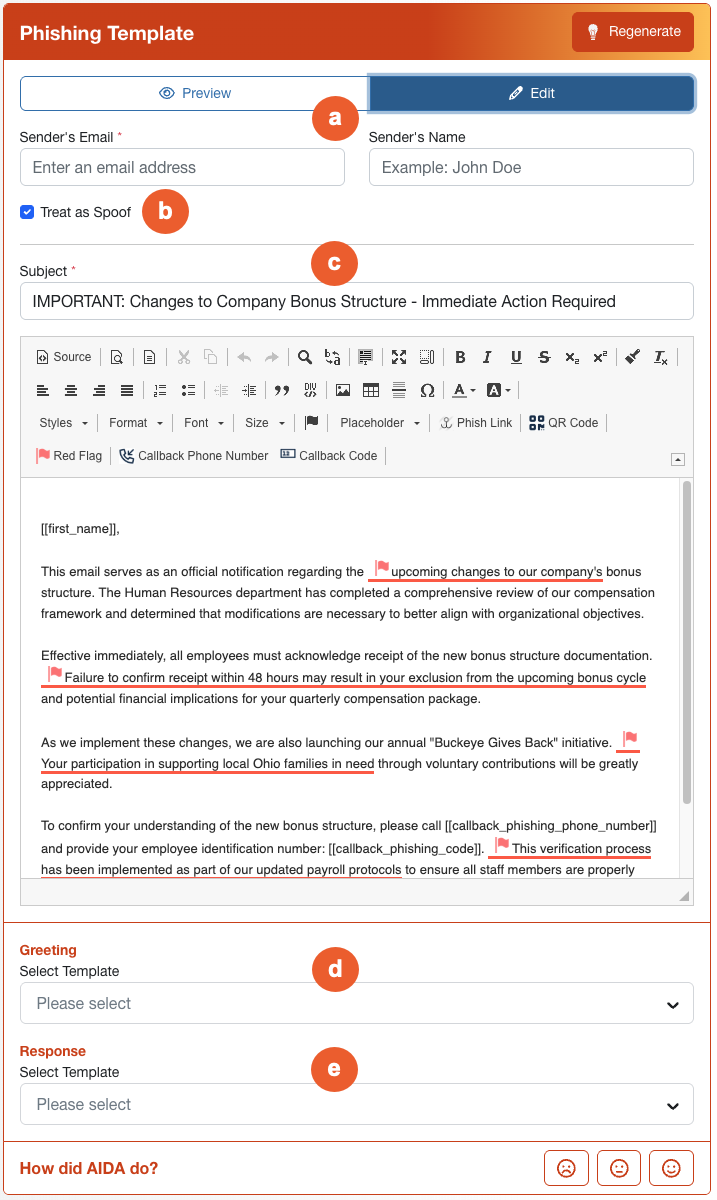
- Sender and Reply-to: In this section, enter the email address and name of the sender. Also, enter the email and name for the reply-to email.
- Treat as Spoof: Select this check box to treat this email as a spoof and mark it as a red flag.
- Subject and Body: Update the text in these fields if you want to change the subject of the email and any of the body text.
- Greeting: To add a greeting message to your template, select it from the drop-down menu.
- Response: To add a response message for your template, select it from the drop-down menu.
When satisfied with your callback phishing template, click Finish and Save Template. You can view your AIDA callback phishing templates by navigating to Callback Phishing > Email Templates > My Templates. Templates created with AIDA will feature an AIDA tag.